

walmart stock is reacting to Q4 FY26 results and you need to know what that means for your money today. The company reported results ahead of the Feb 19, 2026 earnings date, and the market priced in moves given a near-$995.57B intraday market cap, 0.67 beta, and a 52-week range of 79.81–134.69 (WMT).
You’ll get a clear, timely analysis for US and UK investors — including ticker access (NYSE: WMT; UK access via US brokers/CFDs/ISAs where allowed). This is not financial advice, but it will help you make a reasoned decision.
We’ll break down Q4 FY26 results, guidance signals, segment performance, eCommerce momentum, and walmart inventory efficiency. You will see a short preview of what drove the post-earnings reaction, what the market is pricing in, and which catalysts could change the narrative over the next week.
Primary sources I reference later include Walmart Investor Relations, SEC filings, and Nasdaq market data; figures are as of the Feb 19, 2026 date. The decision framework you’ll use: (1) earnings quality vs guidance, (2) valuation vs growth and defensiveness, (3) operational execution, and (4) dividends and buybacks.
Key Takeaways
- Q4 FY26 reaction centers on earnings quality and guidance signals after Feb 19, 2026.
- Market context: ~995.57B market cap, beta 0.67, and wide 52-week range.
- We’ll analyze digital growth, inventory efficiency, and segment trends.
- Valuation vs defensive growth and shareholder returns will guide buy/hold/sell choices.
- This piece offers separate use-cases: long-term compounding, defensive allocation, dividend focus, or tactical timing.
What’s moving Walmart shares today after Q4 FY26 earnings
The Q4 FY26 report posted respectable revenue and per share results, yet the market reacted to the tone of management’s outlook. You saw EPS of $0.74 per share, revenue of $188.91B (up 5.6%), and net earnings of $5.93B. Despite the beat, shares slipped about 1.4% after the call.
Q4 FY26 headline results: EPS, revenue growth, and why the stock dipped
| Metric | Q4 FY26 |
|---|---|
| EPS (per share) | $0.74 |
| Revenue | $188.91B |
| Revenue growth | 5.6% |
| Earnings (net) | $5.93B |
The post-earnings dip was driven by cautious guidance rather than the quarter itself. When management flags slower margin expansion, the market may compress multiples even after solid numbers. That “beat vs raise vs guide” dynamic explains why a good print can still produce selling.
Key catalysts investors are pricing in
- Guidance tone: margin commentary and the near-term outlook are central to re-pricing.
- $30B buyback: sizable buybacks can lift EPS per share over time and signal confidence.
- 5% dividend hike: a steady yield boost that reinforces shareholder return credibility.
Quick market snapshot
| Item | Today |
|---|---|
| Previous close / Open | 126.62 / 128.50 |
| Day range (low–high) | 124.48–130.10 |
| Volume / Avg vol | 42,102,802 / 31,417,360 |
| 52-week range | 79.81–134.69 |
| Market cap (intraday) | $995.57B |
- Pricing investment and promo cadence.
- Mix shift between grocery and higher-margin services.
- Shrink and fulfillment cost trends.
- Services profitability and membership income signals.
Keep an eye on macro cross-currents like rates, consumer stress, and any tariff ruling that could sway futures and sentiment.
What to watch next: operating income trajectory, eCommerce margin progress, membership income growth, and inventory/availability improvements. Those KPIs can reverse the dip by proving the outlook will improve.
walmart stock fundamentals and 2026 financial snapshot
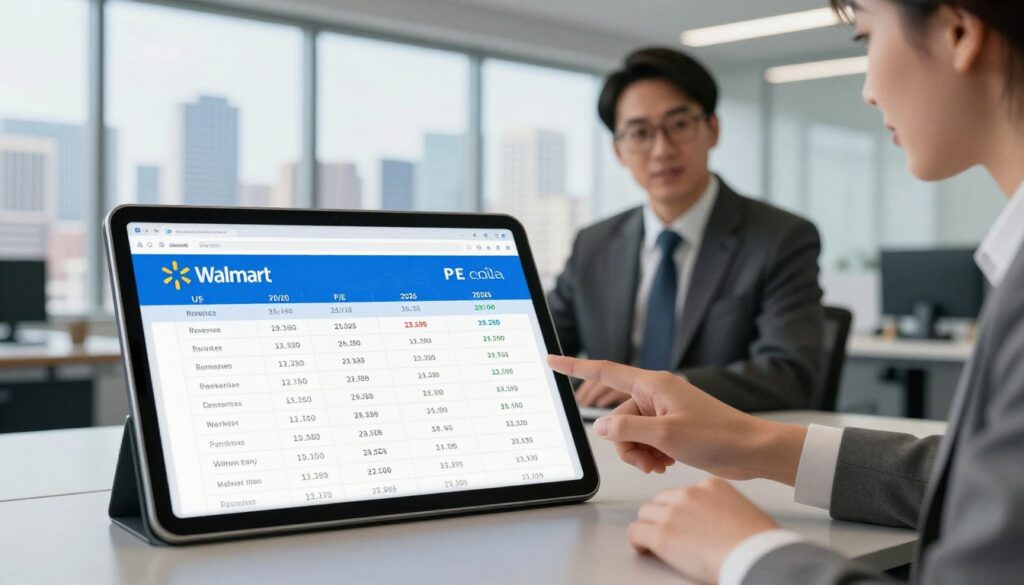
A concise 2026 financial snapshot shows where the business earns, invests, and returns cash to holders. Below is a compact view of the key metrics you’ll use to judge valuation and operating health.
Income statement highlights
The company posts scale: revenue (ttm) of $703.06B with net income available to common at $22.91B. That yields a profit margin near 3.26%.
Large revenue helps with supplier leverage and traffic, but the same scale makes high-percentage growth harder year over year.
Cash flow and balance sheet
Total cash (mrq) sits at $10.58B while levered free cash flow (ttm) is roughly $10.37B. Debt-to-equity is about 66.75%, a level many investors call manageable for a mature, cash-generating retailer.
Profitability and efficiency
ROA (~6.54%) shows solid asset productivity. ROE (~23.66%) reflects returns amplified by leverage. For a low-margin retailer, small cost swings can move earnings materially.
Key trading multiples
| Metric | Value |
|---|---|
| EPS (ttm) | $2.82 |
| Trailing P/E | 44.27 |
| Forward P/E | 33.67 |
| PEG | 3.37 |
| Price/Sales | 1.45 |
“The market often prices this business for defensive cash generation and services optionality rather than pure grocery margins.”
- High multiples reflect a premium for defensiveness, dividends, and digital optionality.
- Levered FCF funds the dividend and buybacks, but capex or working-capital swings could pressure cash available for returns.
- What could break the thesis: forward growth misses estimates and margins compress, causing re-rating even if the business stays large and stable.
Segment performance: Walmart U.S., Walmart International, and Sam’s Club
Breaking results into segments helps you see which parts drive traffic, profits, and future returns.
Walmart U.S. is the engine for traffic and volume. Grocery makes roughly 60% of U.S. sales, with health & wellness at ~12% and general merchandise about 26%. That grocery mix delivers steady footfall and repeat trips, supporting resilience in weak consumer periods.
Price leadership and low prices protect share but compress margin. Your upside comes from services momentum — pharmacy, delivery, advertising and fintech — which can lift profitability if adoption scales.
Sam’s Club
Sam club is a membership-driven wholesale model. About 65% of its sales are groceries and consumables, which fuels basket frequency and loyalty.
Member fees and renewal rates are key. If you see rising member growth, higher basket size, and improved renewals, Sam club will add predictable margin and cash returns versus the broader retail business.
Walmart International
Walmart international exposure is a mix of developed and emerging markets, plus digital assets like Flipkart and PhonePe. That ecosystem offers long-term optionality in payments and marketplace scale.
UK and other investors should watch FX: currency swings can amplify or mute reported results. Always separate constant-currency trends from headline dollar sales to judge real momentum.
| Segment | Key driver to watch | Quarterly KPI |
|---|---|---|
| Walmart U.S. | Traffic & services mix | Comp sales, services revenue |
| Sam club | Membership economics | Renewal rate, member growth |
| Walmart International | Digital penetration & FX | Constant-currency sales, marketplace GMV |
Digital growth and operations: eCommerce, services, and walmart inventory efficiency
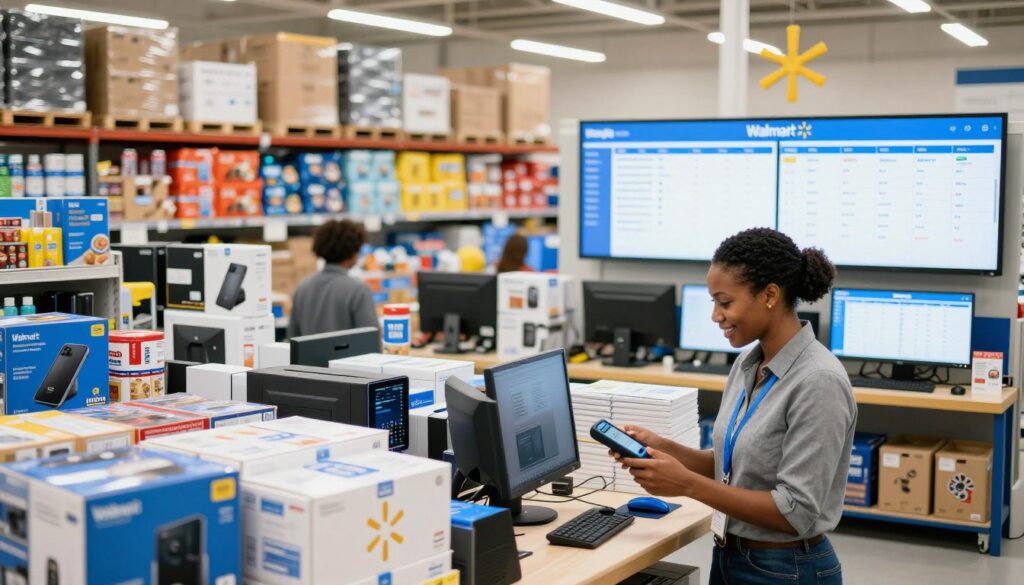
Digital channels and store operations together now shape margins and working capital in ways you must track closely.
Omnichannel and margin structure
Omnichannel means you get goods from a store, an app, or a website. That convenience defends traffic but raises picking, packing, and last‑mile costs.
As online penetration rises, mix shifts toward marketplace revenue, advertising, and subscription services. Those can lift margin over time while delivery and returns weigh near term.
High-frequency categories and traffic
Grocery and health & wellness drive repeat visits and raise lifetime value. Higher visit frequency helps cross‑sell general merchandise and paid services.
Watch same‑store sales in those categories to judge whether digital gains are increasing store traffic or just shifting fulfillment costs.
walmart inventory turns, availability, and working capital
walmart inventory discipline matters in 2026. Faster inventory turns free cash and lower markdown risk.
Monitor inventory growth vs. sales growth and in‑stock rates. Rising inventory with flat sales signals working‑capital stress.
| Metric | Why it matters | What to watch |
|---|---|---|
| Inventory turns | Shows working capital efficiency | Turns vs prior year, days inventory |
| In‑stock availability | Drives sales and customer experience | OTIF and on‑shelf % |
| Fulfillment cost per order | Impacts margins on eCommerce sales | Cost trends and guidance commentary |
AI, automation, and productivity levers
AI helps demand forecasting, merchandising, personalization, and labor scheduling. Practical gains include fewer markdowns and improved route efficiency.
Examples to watch: forecasting accuracy metrics, pilot expansions of automation, and commentary on labor hours saved.
Execution risks and investor signals
Shrink, fulfillment costs, and labor productivity can pressure profit even when sales rise. You should use three quarterlies to judge direction.
- Check guidance on operating income and any notes on shrink trends.
- Compare fulfillment cost per order and hours per store to prior periods.
- Look for service revenue scale and margin improvement in management comments and the e-commerce sales context.
“Operational execution will determine whether digital growth becomes a durable profit engine or a margin drag.”
Valuation, dividends, and shareholder returns for long-term investors
Put simply: price today reflects a mix of reliable earnings and optional digital growth.
Is wmt stock expensive?
Trailing P/E sits at 44.27 with a forward P/E near 33.67 and a PEG of 3.37. That premium shows investors pay for a defensive earnings stream plus services upside.
When yields rise, high multiples can compress; when rates ease, the market often rewards stability. Use P/E vs expected growth, not P/E alone, to judge whether the current price is fair.
Dividend outlook
The forward dividend is about 0.94, producing a ~0.74% dividend yield after a recent 5% raise. The increase signals confidence.
Sustainability depends on free cash flow after capex and working capital. Watch FCF trends and any persistent uptick in fulfillment or shrink costs.
Capital returns and buyback math
A $30B buyback can meaningfully lift EPS if executed below intrinsic value and done steadily. For example, repurchasing 2–3% of shares annually reduces share count and supports per share compounding over time.
Execution matters: pace and price paid determine the real boost to per share metrics.
Timing: when to invest
If guidance slips but fundamentals remain intact, a guidance-driven pullback is a reasonable buying opportunity. You can also dollar-cost average to build a defensive core position over time.
Use the 52-week high/low (79.81–134.69) as a guide: a move toward the low after a clear fundamental issue is different from a short-term drawdown tied to rates.
Best time to sell walmart shares
- Sell triggers: sustained guidance deterioration, structural margin compression, or persistent execution failures (shrink/fulfillment).
- Also consider selling if valuation becomes detached from achievable growth and cash flow.
“Base case: slow but steady cash returns and modest growth. Bull case: services scale and margin expansion. Bear case: persistent margin pressure and execution shortfalls.”
For deeper valuation context, see a focused analysis on valuation and recent price action.
Conclusion
This quarter confirmed the company’s scale but left questions about near-term profit momentum after management’s outlook on Feb 19, 2026.
Buy / Hold / Sell: Buy for long-term investors who value steady dividends, the $30B buyback, and execution improving services and eCommerce. Hold if you need confirmation of margin recovery. Sell only if guidance deteriorates further or execution on shrink and fulfillment worsens.
If you trade tactically, wait for clearer confirmation in the next quarterly guidance and a price move off the 52‑week low/high range before adding exposure.
Image plan: place an optimized chart image at the end of Section 2 with alt=”walmart stock Q4 FY26 earnings chart — price, revenue, and guidance”.
Embed suggestions (copyright-free): official Walmart earnings update and a Nasdaq market explainer embedded in the article body for education and context.
What to watch next: guidance cadence, buyback pace, dividend updates, services margin, inventory availability, and tariff ruling impact on wholesale merchandise flows.
References: Walmart Investor Relations, SEC filings (10‑Q/10‑K), Nasdaq market data, and major financial data providers for Feb 19, 2026 figures.