
Is it still worth learning crypto for beginners in 2026, or will the risks outweigh the rewards?
You’ll learn why this skill matters now: more places to buy, more products to use, and more ways to make mistakes if you don’t know the basics.
Cryptocurrency is digital money that does not need a central bank. Transactions are verified and recorded on blockchain, a hard-to-change public ledger. Volatility is a core risk, so you should grasp fundamentals before you buy.
This guide will help you understand cryptocurrency in plain English, see how blockchain transactions work, and make a small first purchase safely. You’ll get clear explanations of investing versus trading, wallets, fees, taxes, and common risks.
Start small, focus on established assets, and protect your security before chasing returns. This is educational content, not individualized investment or tax advice. Rules and tax treatment vary across the United States, Canada, and Europe.
Key Takeaways
- Learning basics in 2026 matters because access and products have expanded.
- Cryptocurrency uses blockchain to record transactions without a central bank.
- Volatility means quick gains and quick losses; treat it like high-risk finance.
- Focus on security, start small, and prefer established assets first.
- This article is educational and not personalized legal or tax advice.
Why crypto for beginners matters in 2026
As platforms grow and user numbers rise, the market now has more roads — and more traps — to navigate. You face more apps, more on-ramps, and a broader set of assets than a few years ago. That makes learning basic market behavior a practical first step.
Mainstream adoption and a bigger market to navigate safely
Global market cap passed $4 trillion in July 2025 (CoinGecko), which shows scale and why new investors should pay attention. More people entering markets creates liquidity but also more choices that can confuse you.
Regulation, taxes, and rising expectations
Exchanges and custodians face clearer rules in many regions, but laws still differ across the United States, Canada, and Europe. That means you should verify which rules apply to your accounts and keep records of trades early.
Prioritize safe navigation: set limits, understand basic security, and track taxes before chasing opportunities. If you want a broader read on investing in 2026, see this thinking-about-investing piece.
| Area | What changed | What you should do |
|---|---|---|
| Market size | Passed $4T in 2025 | Learn how markets behave; start small |
| User experience | Smoother apps, more on-ramps | Choose reputable platforms |
| Regulation & taxes | More clarity, different rules by region | Verify rules and keep records |
Crypto for beginners: a simple overview of what cryptocurrency is
At its simplest, cryptocurrency is digital currency you can send, receive, or hold without a bank approving each transaction.
Digital money without a central bank
Decentralization means no single company keeps the “official” record. Instead, many computers on the network share the ledger. That shared model reduces a single point of control.
Blockchain as a public, hard-to-change ledger
Blockchain is the public record of transactions. The network checks and agrees on each entry, so tampering is very difficult. That makes past records reliable.
Coins vs tokens in plain English
Coins usually run on their own blockchain; Bitcoin is a common example. Tokens live on another platform, like many tokens built on Ethereum.
- Some cryptocurrencies aim to be digital money.
- Others act as fuel for apps or services (utility tokens).
| Concept | Simple meaning | Practical note |
|---|---|---|
| Cryptocurrency | Digital currency you can hold and send | Use wallets or exchanges to store and trade |
| Blockchain | Shared, hard-to-change ledger of transactions | Helps prevent tampering and fraud |
| Coins vs tokens | Native chain vs built-on-chain assets | How you store them can differ |
Next: how transactions actually move on the network and why fees and speed vary depending on the wallet or exchange you use.
How blockchain transactions work behind the scenes
Behind a simple transfer lies a chain of validation, cryptography, and recorded proof.
What actually happens when you send or receive a payment
When you send a payment, you enter the recipient’s wallet address, pick an amount, and confirm the transaction on your app or device.
That request is broadcast to the network and waits for validators to check it.
- Your wallet signs the request to prove it came from you.
- Validators check you have the funds and that the signature is valid.
- If valid, the transaction is added to a block and recorded on the public ledger.
Why cryptography and public ledgers prevent counterfeiting
Cryptography proves ownership: only the holder of a private key can authorize a transfer. That stops easy forgery.
The public ledger records every completed transaction. Because many computers keep copies, changing history is extremely hard.
Result: transactions are traceable and harder to counterfeit, which improves overall security and trust in the technology.
Network fees, transaction speed, and why costs vary
Fees are the cost to get included in the next block. They rise when demand is high and fall when the network is quiet.
Some networks confirm quickly; others take longer if congested. That affects the finality of a transaction and its practical value.
| Characteristic | When low | User outcome |
|---|---|---|
| Fees | Network idle | Small transfers make sense |
| Speed | Low congestion | Fast settlement |
| Finality | Strong validator consensus | Less chance of reversal |
What moves crypto prices and crypto markets
Market prices change when buyers and sellers disagree on value, and that push-pull sets the pace of short-term moves. This section explains the basics so you can read price movements without hype.
Supply, market cap, and liquidity basics
The current price is simply the last trade agreed by a buyer and a seller — not an official valuation.
Market cap is price × circulating supply; it helps you compare relative size between coins.
Liquidity means how many buyers and sellers exist. Deep, liquid markets have tighter spreads and smoother trading than thin ones.
Key events that drive volatility
- Regulatory announcements or guidance
- Exchange listings, delistings, or security breaches
- Major headlines and shifting macro risk sentiment
- Large holders moving funds or platform integrations
Why price swings create both opportunity and losses
Markets run 24/7, some venues offer leverage, and sentiment spreads fast. That amplifies price swings and makes short-term moves sharp.
Result: you can find entry points and returns, but big swings can wipe out gains quickly if you chase momentum or over-size a position.
| Factor | Effect | Practical note |
|---|---|---|
| Liquidity | Smoother prices | Prefer liquid markets for larger trades |
| News | Fast volatility | Check reliable sources before acting |
| Leverage | Amplified moves | Use risk controls if you trade |
Ways you can participate: investing, trading, and indirect exposure
Choose a path that fits your time, risk tolerance, and interest in learning custody and market mechanics.
Long-term investing vs short-term trading
Investing focuses on holding assets for months or years and leans on adoption trends and fundamentals. It usually needs less daily attention and less emotional stress.
Trading aims to capture short-term swings. Traders must watch markets, manage risk, and accept higher fees and work load.
Dollar-cost averaging as a simple plan
DCA means investing a fixed amount on a schedule. It reduces stress about timing and helps investors build a position over time.
Funds, ETPs, and ETFs for indirect exposure
Funds and ETFs let you gain exposure without self-custody. They ease key management but add fees and product rules. Availability varies by region.
Security and complexity tradeoffs
- Self-custody = more control, more responsibility.
- Funds = easier custody, less direct control, ongoing fees.
- Leveraged products can magnify losses and are not recommended for most new traders.
| Approach | Time horizon | Effort & skill | Security/complexity | Typical fees |
|---|---|---|---|---|
| Long-term investment | Months–Years | Low–Medium | Self-custody optional | Trading fees, occasional custody costs |
| Short-term trading | Minutes–Months | High | Requires active platform management | Higher trading fees, spreads |
| Funds / ETPs / ETFs | Months–Years | Low | Custody handled by provider | Management fees, product charges |
Quick decision guide: pick investing if you want low maintenance, choose trading if you have time and risk tolerance, or use funds if you prefer simpler custody and regulated access.
Getting started step by step with your first crypto purchase
Choosing the right exchange is the single biggest decision before you place your first small buy. Follow a short plan so you can get started without panic.

Pick a reputable platform and know CEX vs DEX
Look for a platform with a solid track record, 2FA, transparent fees, and clear regulatory standing in the United States. Examples include Coinbase, Gemini, Robinhood, and Webull.
Centralized exchanges (CEX) act as middlemen and often hold assets for you and require ID checks. Decentralized exchanges (DEX) let you trade on-chain from your wallet and offer more control but more complexity.
Create and fund your account
Sign up with a unique email, use a password manager, and enable 2FA. Expect identity verification (KYC) on most US platforms; this is normal and required by law.
Fund by bank transfer or card. Do a small test deposit first so you understand settlement times and limits.
Place a small first buy and check costs
- Pick a small amount you can afford to lose.
- Choose market or limit order at a basic level.
- Avoid hype and meme-style FOMO when selecting coins.
Fees checklist: check trading fee or spread, deposit/withdrawal charges, and network fees before you confirm.
Wallets, storage, and basic crypto security
Keeping your digital assets safe starts with understanding how wallets actually work.
A wallet stores the private keys that let you send and receive cryptocurrency. It is not a bank account: if you lose keys, recovery may be impossible.
Hot wallets vs cold wallets and when each makes sense
Hot wallets are online and easy to use. They are good for small, everyday amounts.
Cold wallets stay offline. Use them for larger holdings or long-term storage to reduce exposure to hacks.
Private keys, seed phrases, and what “self-custody” means
If you control the private keys or seed phrase, you control the funds. That is self-custody.
Write your seed phrase on paper, store it offline, and never share it. Anyone asking for that phrase is almost always a scam.
2026 security and risk note: scams, phishing, and exchange hacks
In 2026, phishing links, fake support accounts, and “wallet verification” scams remain common. Exchanges can still be targets for hackers.
Use strong passwords, enable 2FA, verify URLs, and treat unsolicited messages with suspicion. Test small transactions when you use a new address.
- Double-check addresses before sending.
- Keep devices and apps updated.
- Use cold storage for large balances.
| Storage type | Main advantage | Main risk |
|---|---|---|
| Hot wallet | Convenience for everyday use | Online exposure, phishing, device malware |
| Cold wallet | Stronger offline protection | Physical loss or damaged backup |
| Exchange custody | Ease, no direct key handling | Platform hacks or withdrawal limits |
Quick actions to reduce loss:
Test a small transfer, store seed phrases securely, and split holdings between hot and cold storage to balance convenience and security.
Benefits, risks, and a quick pros and cons list
Practical rewards exist, but they come with clear trade‑offs you must accept early. Below are realistic benefits and the immediate risks you should plan for from day one.
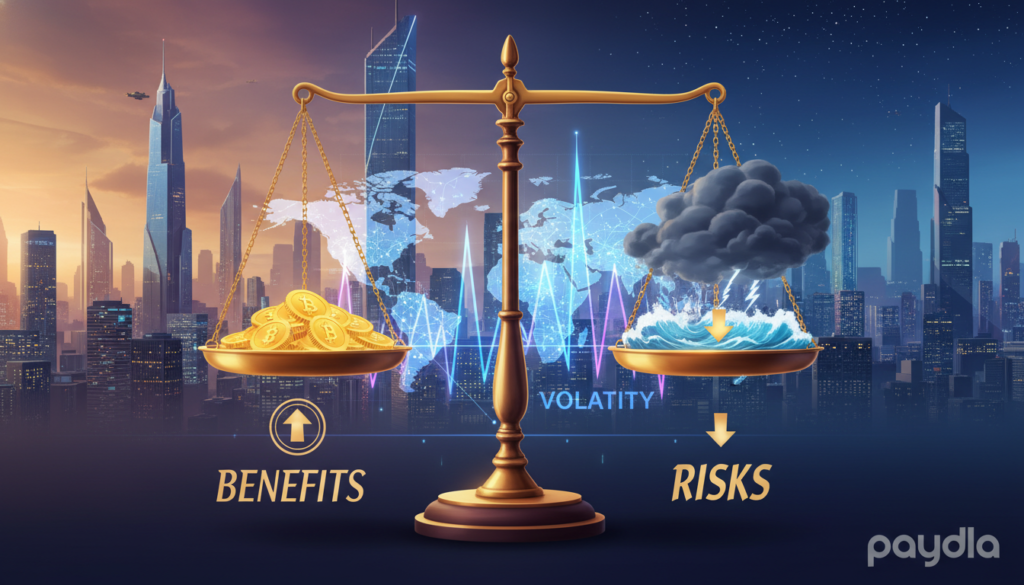
Benefits you can realistically expect
- Global access: you can send value across borders with an internet connection.
- Speed: many networks enable faster transfers than some legacy rails.
- Lower costs (often): some chains offer low transaction fees, though that can change when networks are busy.
- Participation in new tech: you can use and learn financial tools that are evolving quickly.
Risks you should plan for from day one
- Volatility: price swings are normal; plan position sizing and worst‑case scenarios.
- Security burden: if you lose keys or send to the wrong address, consumer protections are limited.
- Costs can spike: network fees rise during congestion, so “cheap” is not guaranteed.
- Environmental concerns: some transaction types and older networks use more energy; check network design if this matters to you.
Pros and cons at a glance
- Pros: accessibility, speed, transparency, innovation.
- Cons: price swings, security responsibility, variable fees, regulatory uncertainty.
Note: If you want a short refresher on what cryptocurrency is before you act, see what cryptocurrency is.
Beginner-friendly best practices for managing risk and avoiding common mistakes
Good risk management begins with a simple, written plan that defines your goal and limits. Write one sentence stating whether your aim is learning, long-term investment, or active trading. Add a realistic time horizon and a maximum loss you can live with.
Set a goal, a time horizon, and a maximum loss you can live with
Use this template: Goal = __; Time horizon = __; Max loss = __ (amount you can afford to lose).
Start small, diversify carefully, and avoid meme-coin FOMO
Begin with small amounts and treat early buys as tuition while you learn market behavior. Diversify across a few established assets before exploring smaller projects.
Use basic risk controls if you trade, like stop-loss rules
If you trade, limit position size, set stop-loss rules, and avoid leverage as a new trader. Remember: stops help manage downside but do not guarantee protection in fast markets.
Track taxes and keep records of transactions
Keep clear records of buys, sells, swaps, fees, timestamps, and your cost basis. The IRS requires reporting profit and loss on digital assets — see IRS guidance on digital assets.
- Internal resources: Beginner guide to crypto wallets and seed phrase safety
- Internal resources: How to manage crypto taxes and track cost basis
- Market context: CoinGecko market data
“Plan first, trade second.”
Common beginner questions you’ll want answered before you invest
Before you invest, it’s helpful to get clear answers to the questions most new investors ask. Below are short, practical responses to three frequent concerns so you can open an account with less worry.
Is investing safe if I use a reputable exchange and strong security?
Reputable platforms reduce risk, but your security habits matter most. Use 2FA, strong passwords, and beware of phishing. Enable withdrawal allowlists when available.
Note: even large exchanges can face outages or incidents. For long-term holdings, consider moving assets to cold storage you control.
How much money should I start with?
Start with an amount you can afford to lose. Treat early buys as learning. A recurring dollar-cost averaging plan is a good example — small, scheduled purchases reduce timing stress.
Which major currencies are generally more established?
Bitcoin (BTC) and Ethereum (ETH) are often viewed as more established coins. That said, “established” is not the same as guaranteed safe.
Stablecoins like USDC or USDT aim to track the dollar, but they carry issuer and platform risks — this is an important example to check before you trust an account.
Conclusion
Start with one clear step today and build habits that protect your money and time.
Beginner formula: learn the basics, pick a reputable platform, make a small first buy, secure your wallet and keys, and keep records for taxes and fees.
In 2026, cryptocurrency is more accessible but also more complex. This way of accessing markets brings real opportunities and real risk. Treat security and decision-making as part of every move.
Choose one next step now: enable 2FA, read a seed-phrase guide, or map a small DCA plan. Commit a little time each week to track markets, review fees, and update your limits as you learn.